The Ultimate Daily Sunscreen Guide: What SPF Really Means & Why Mineral Protection is Your Skin’s Best Friend
If there is one non-negotiable rule in professional skin health, it’s this: Daily sun protection is the single most important step in your skincare routine.
No serum, peel, or high-tech facial treatment can counteract the damage caused by unprotected UV exposure. Yet, sunscreen remains one of the most misunderstood products on the shelf. From decoding SPF numbers to figuring out how much you actually need, sun protection can feel overly complicated.
Here is everything you need to know about SPF, how sun damage accelerates aging, why mineral sunscreen is a game-changer, and how to choose the perfect formula for your skin.
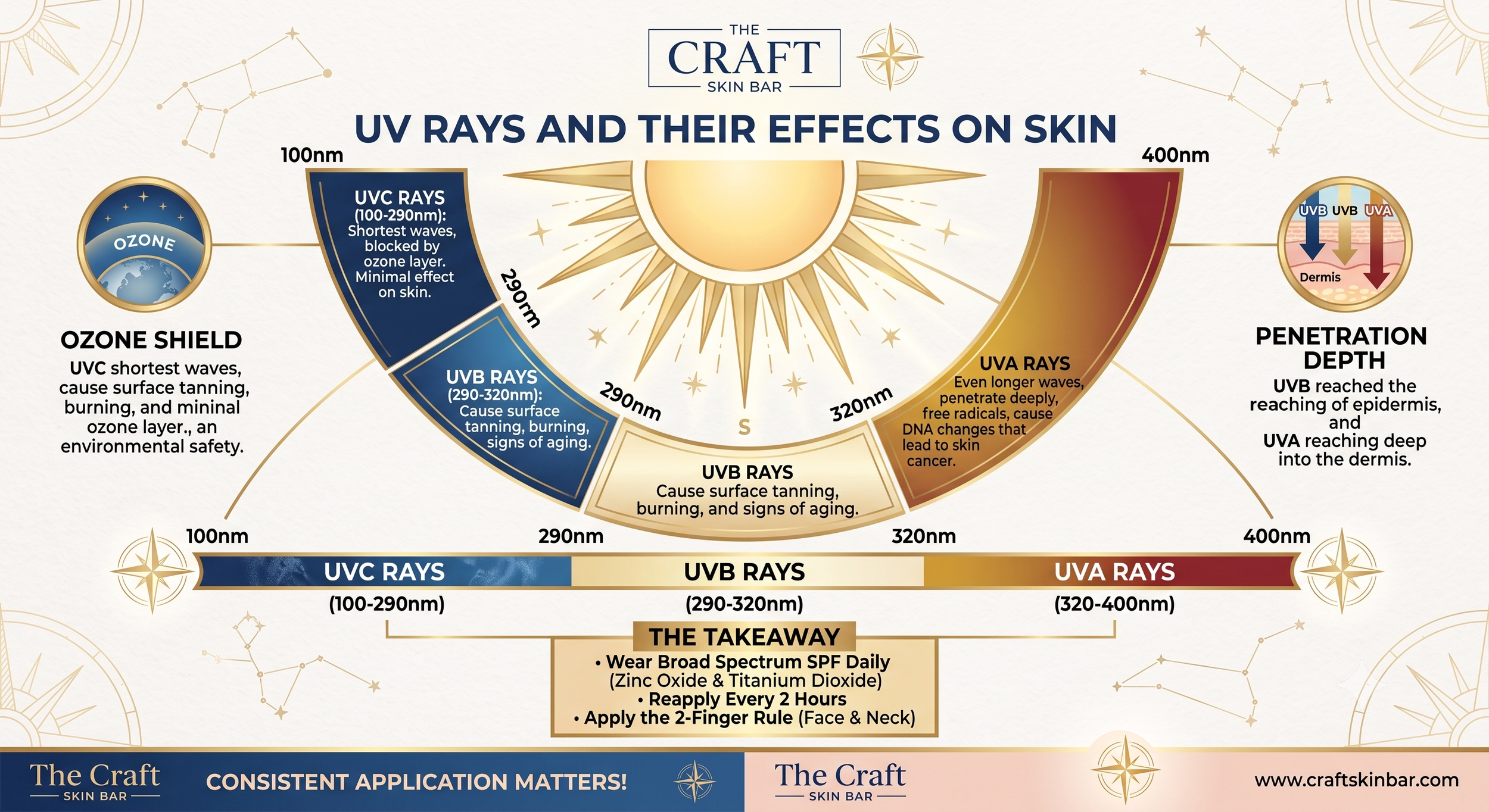
UV Rays and their effects on skin
What is SPF and What Does It Stand For?
SPF stands for Sun Protection Factor. It measures how effectively a sunscreen protects your skin against UVB (Ultraviolet B) rays—the primary wavelengths responsible for sunburns, surface cell damage, and direct DNA harm.
However, SPF alone only tells half the story:
UVB Rays (Burning): Direct sunlight that burns the top layer of skin and damages cell structure.
UVA Rays (Aging): Deeper-penetrating rays that are present year-round—even on cloudy days and through glass windows. UVA rays break down collagen, cause hyperpigmentation, and create long-term structural aging.
To protect against both, always look for the words "Broad Spectrum." Broad spectrum ensures your skin is shielded from both burning UVB rays and aging UVA rays.
How Much Protection Does SPF Actually Provide?
A common misconception is that SPF 100 provides twice as much protection as SPF 50. In reality, protection scales on a curved graph rather than a linear line:
SPF 15 blocks approximately 93% of UVB rays
SPF 30 blocks approximately 97% of UVB rays
SPF 50 blocks approximately 98% of UVB rays
While no sunscreen blocks 100% of UV rays, SPF 30 to 50 provides optimal protection for everyday wear.
The Gold Standard of Anti-Aging
If you could only use one anti-aging product for the rest of your life, sunscreen is it. Up to 80% of visible skin aging—known as photoaging—is caused by daily, cumulative sun exposure.
When UV light hits unprotected skin, it triggers a chain reaction:
Collagen & Elastin Breakdown: UV radiation produces free radicals that destroy the support structure of your skin, leading to premature sagging, fine lines, and deep wrinkles.
Hyperpigmentation & Sun Spots: Radiation stimulates overproduction of melanin, creating uneven skin tone, stubborn dark spots, and melasma flares.
Impaired Skin Barrier: Sun exposure weakens the cutaneous barrier, leaving skin chronically dehydrated, sensitized, and prone to inflammation.
Wearing broad-spectrum sunscreen every single day acts as a physical shield, allowing your skin cells to focus on repair and renewal rather than fighting constant environmental stress.
The 3 Types of Sunscreen: A Quick Breakdown
When shopping for sunscreen, you’ll run across three main categories based on their active UV-blocking ingredients:
Chemical Sunscreens: Formulated with carbon-based compounds (like avobenzone, octisalate, and octocrylene) that absorb UV rays and convert them into heat.
Mineral (Physical) Sunscreens: Formulated with naturally derived minerals—Zinc Oxide and Titanium Dioxide—that sit on the skin's surface to physically scatter, reflect, and absorb UV light.
Combination Sunscreens: Utilize a hybrid blend of both mineral and chemical active ingredients to balance texture and coverage.
Why Mineral Sunscreen is the Ultimate Choice for Skin Health
While each type has its place, mineral sunscreen is the gold standard for healthy, calm, and resilient skin. Here is why mineral active ingredients excel:
Gentle & Non-Irritating: Mineral active ingredients like Zinc Oxide are naturally soothing, anti-inflammatory, and gentle on sensitive or compromised skin.
Ideal for Acne & Rosacea: Unlike chemical filters that trap heat in the skin (which can trigger inflammation, flushing, and breakouts), mineral formulations reflect UV rays without raising skin temperature.
Immediate Protection: Mineral sunscreens work as soon as you apply them—no waiting 20 minutes for chemical absorption required.
Photostable Defense: Zinc Oxide does not degrade easily when exposed to direct sunlight, providing reliable, broad-spectrum protection throughout wear.
Post-Treatment Safe: If you undergo professional chemical peels, microneedling, or facial treatments, mineral SPF is the safest choice for delicate, healing tissue.
The Real Problem: Most People Don't Use Enough (or Reapply!)
Even the best sunscreen won't protect your skin if it isn't applied correctly. Two major mistakes prevent people from getting the full SPF listed on the bottle:
1. Under-Applying
To achieve the full SPF rating on the package, you need:
For the Face & Neck: Approximately 1/4 teaspoon (or the length of two full fingers).
For the Body: About 1 full ounce (a shot glass amount).
Most people apply only half of what is needed, which slashes an SPF 30 down to an effective protection level of SPF 5 or 10.
2. Skipping Reapplication
Sunscreen degrades over time as it interacts with natural skin oils, sweat, and sunlight.
Outdoor Rule: Reapply every 2 hours when spending time outside.
Water & Sweat: If you are swimming or sweating, reapply immediately after drying off with a towel.
Demystifying "Water Resistance"
It’s important to clarify: There is no such thing as "waterproof" or "sweatproof" sunscreen. The FDA banned those terms because all sunscreens eventually wash off.
Instead, look for Water Resistant labels, which are strictly tested and categorized into two ratings:
Water Resistant (40 minutes): Maintains its stated SPF protection after 40 minutes of swimming or sweating.
Water Resistant (80 minutes): Maintains its stated SPF protection after 80 minutes in the water.
Pro tip: Friction from towel drying removes your sunscreen immediately—always reapply right after drying off!
Find Your Perfect Fit: Featured Sunscreens at The Craft Skin Bar
At The Craft Skin Bar, every skin type deserves customized, professional-grade sun protection that feels luxurious to wear. Here are my favorite mineral and high-performance sunscreens available in the studio:
1. EltaMD — The Dermatologist & Esthetician Favorite
EltaMD is legendary for lightweight, incredibly cosmetically elegant mineral and hybrid formulations.
Who It’s For: Sensitive skin, rosacea, hyperpigmentation, and post-procedure care.
Hero Picks: Formulations rich in Zinc Oxide and niacinamide that soothe redness while providing seamless broad-spectrum defense.
2. Face Reality Skincare — The Acne-Safe Shield
If you struggle with clogged pores or active acne, finding a safe SPF can feel like a gamble. Face Reality takes the guesswork out of sun care with guaranteed non-comedogenic formulas.
Who It’s For: Acne-prone, oily, or sensitive skin types who need 100% pore-safe protection.
Hero Picks: Lightweight, soothing daily SPFs infused with skin-nourishing antioxidants that protect without causing breakouts.
3. Circadia — High-Performance Anti-Aging & Botanical Protection
Circadia blends advanced peptide technology and potent antioxidants with daily UV defense to protect skin at a cellular level.
Who It’s For: Aging skin, environmental defense, dryness, and hyperpigmentation prevention.
Hero Picks: Hydrating, broad-spectrum formulas that protect against UV damage while nourishing the skin barrier with plant-derived antioxidants.
Protect Your Investment
Great skin doesn't happen by chance—it happens by appointment and daily commitment. Protecting your skin from the sun is the best investment you can make in your long-term glow.
Ready to find your perfect daily SPF fit? Stop by The Craft Skin Bar or send a message to get personalized recommendations tailored to your unique skin type and lifestyle!
